Metadata blocks
Metadata blocks contain optional information about the show itself instead of about what the drone is supposed to do: the unique identifier of the show the file belongs to, and the index of the drone within the show. This information can be used to correlate a show file with the show it was generated from and to tell which drone in a fleet mission a particular file was created for.
The body of a metadata block is a sequence of tag-length-value (TLV) entries. Each entry consists of a one-byte tag, followed by the length of the value of the entry in two bytes (unsigned, little-endian), then the value itself. Entries follow each other without any padding or alignment.
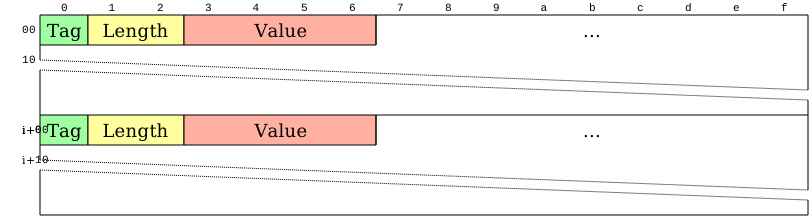
The following tags are currently defined:
The show ID entry (tag = 0x00) holds the unique identifier of the show. Its value is four bytes long and it is treated as an arbitrary binary blob: the format assigns no meaning to the individual bytes and no byte order to the blob as a whole, so identifiers generated by different tools can be used as-is. Parsers should reject blocks in which the length of this entry is not four.
The drone index entry (tag = 0x01) holds the index of the drone within the show. Its value is two bytes long, consisting of a single unsigned 16-bit little-endian integer. Parsers should reject blocks in which the length of this entry is not two.
Defaults and parsing rules
Tags are optional: when the block does not contain a show ID entry, the unique identifier of the show is implicitly assumed to be an all-zero blob; similarly, when the block does not contain a drone index entry, the drone is implicitly assumed to have index zero. A skyb file may also omit the metadata block altogether, which has the same effect as an empty block.
Parsers must skip entries with tags that they do not understand; this allows the block to be extended with new tags in the future without breaking older parsers. When the same tag appears multiple times in the same block, the last occurrence wins.